Chapter 1
The Stern–Gerlach Experiment
This experiment was devised by Stern and Gerlach in 1921 with the aim of measuring the magnetic moment of individual atoms. The first trials were carried out with silver atoms. The results went beyond every expectation, bringing to light unexpected behaviours that today we can use as a starting point for the study of Quantum Mechanics.
Description of the experiment.
An atom with its magnetic moment m can be pictured as a small magnet (fig. 1). If the magnet is placed in a magnetic field, opposite forces act on its poles. If the field is non-uniform the forces are not balanced and the magnet accelerates. The direction in which the magnet accelerates depends on the field gradient and on the orientation of the magnetic moment m; for example, in the figure the magnet accelerates upwards.

Figure 2 shows the magnetic circuit that produces a non-uniform field in the air gap.

The Stern–Gerlach experiment is carried out by sending a beam of silver atoms, with a given velocity v, through the shaped air gap (fig. 3).

Under the action of the magnetic field the atoms are deflected and, at the end of their path, are deposited on a glass slide. From the measured amount of deflection and the field gradient one can determine the magnetic moment.

The atomic beam is generated by vaporising silver inside a small furnace with a tiny hole (fig. 4); the atoms that escape through the hole pass through a pair of slits that focus the beam. The whole path, from the furnace to the glass slide, is kept under vacuum, to prevent the atoms from colliding with the molecules that make up the air and stopping before they reach the slide.
Description of the experimental apparatus.
The following figures show some drawings of an experimental apparatus designed in draft form in the LAFIDIN teaching laboratory.
Figure 5 shows the chamber where the silver is vaporised and a tube on which the first beam-collimating slit is mounted. The crucible is brought to about 1100–1200 °C. Merely melting the silver is not enough: one must go high enough for the vapour pressure to produce a beam of useful intensity, while staying below the threshold beyond which the atoms begin to collide with one another as they cross the aperture and the beam loses its effusive character. Heating is provided by an electric resistance furnace inside which the crucible is placed.

Figure 6 shows the chamber enclosing the pole pieces. The second collimating slit is mounted at its entrance, and the glass slide at its exit.
The whole beam path is kept within one metre: at the working pressure of about 10⁻⁵ mbar the mean free path of the silver atoms is several metres, far longer than the beam, so collisions with the residual gas remain negligible.
The two slits are sized so that the beam divergence stays much smaller than the deflection angle. The long path helps here too: it allows apertures far wider than those used by Stern and Gerlach, and hence a more intense beam and shorter exposure times.
The shape of the pole pieces is designed to make the field as non-uniform as possible in the region crossed by the beam.

Figure 7 shows the complete magnetic circuit that produces the field configuration. Note that the chamber containing the pole pieces is made of stainless steel; this material is not ferromagnetic and therefore does not short-circuit the magnetic flux.

Figure 8 shows all the parts assembled and describes the various steps of the experiment.

Silver powder is placed in the alumina crucible, which is then connected to the rest of the apparatus by a spherical joint.
The vacuum pump is switched on and brings the pressure down to about 2⋅10-5 mbar. At this pressure the mean free path of the silver atoms is several metres, i.e. more than ten times the beam length: the fraction of atoms lost by collision with the residual gas stays below 10%.
The furnace is powered and, after some time, the crucible reaches the working temperature of 1100–1200 °C, well above the melting point of silver (962 °C), so that the vapour pressure is high enough to produce an effusive beam of useful intensity.
The molten silver evaporates from the surface of the bath: the atoms emitted in all directions cross the crucible aperture and, of these, the ones that pass through the two slits form a well-collimated beam.
The atoms that have passed through the two slits travel in the air gap between the pole pieces, are deflected, and at the end of their path are deposited on a glass disc placed at the far end of the apparatus.
After a certain time the furnace is switched off, air is let into the chambers, and the glass slide is removed. The silver deposit, only a few atomic layers thick, is not visible to the naked eye: it must be developed by exposing the slide to sulphur vapour, which converts the silver into dark silver sulphide — the same technique used by Gerlach in 1922. The deflection is then read under a microscope with a micrometric eyepiece.
Expected results.
On the slide, classical physics leads one to expect a single patch, spread along the gradient: the magnetic moments of the atoms are randomly oriented, and each orientation gives a different deflection. What is observed instead are two distinct deposits, one deflected upwards and one downwards. From the amount of deflection and the field gradient one obtains the magnetic moment of the individual atoms.
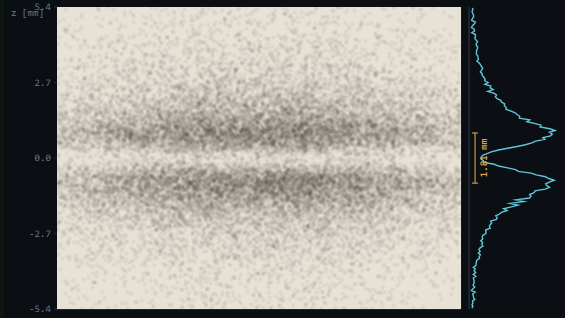
The size of the separation depends on the gradient the pole pieces can actually achieve, and will be determined at the construction stage. With a geometry of this kind one expects an order of magnitude of a few millimetres, against the ~0.2 mm obtained by Stern and Gerlach in 1922: a splitting of that order could be read and measured directly, without resorting to micrographs.
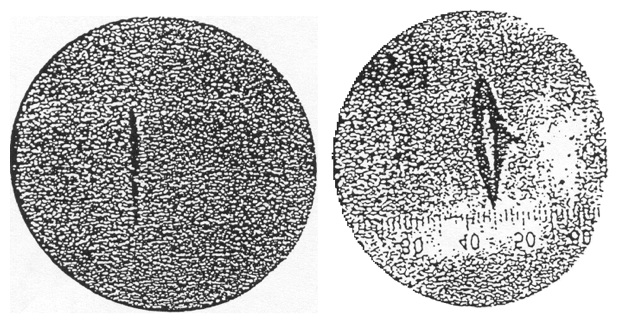
The two traces will not be point-like. Since the deflection scales as and the atoms leave the furnace with a Maxwellian velocity distribution, each trace will be elongated, with a sharp maximum and a tail directed outwards. The 1922 micrographs show instead a lip-shaped figure, the two traces parting in the middle and meeting again at the ends: in Gerlach’s magnet the gradient varied along the slit and vanished at its edges, whereas here the pole pieces are sized to keep it uniform across the whole width of the beam.
▶Try the simulated laboratory · run the Stern–Gerlach experiment→
Interpretation of the results.
The fact that the beam splits into two distinct beams appears very strange from the point of view of classical mechanics.
The atoms leaving the furnace should have magnetic moments oriented at random — some upwards, some downwards, to the left, to the right, at forty-five degrees and at every possible angle. Atoms whose magnetic moment is tilted with respect to the vertical should be deflected less, those with a horizontal magnetic moment should not be deflected at all, and in the end a spread-out smear should have appeared on the slide. The beam should merely have broadened, not split.
The experimental observation shows us that, when we measure the z-component of the magnetic moment of a silver atom, we can obtain only two values, +m0 and –m0. There is no good explanation of this fact in terms of classical mechanics; to understand this phenomenon one must study Quantum Mechanics.